Your 4-Week Bocconi Test Study Program

Your 4-Week Bocconi Test Study Program
A focused 4-week Bocconi Test program combining diagnostic testing, daily timed practice, and progressive full-test simulations gives motivated students the clearest path to measurable score gains. Here is the plan at a glance:
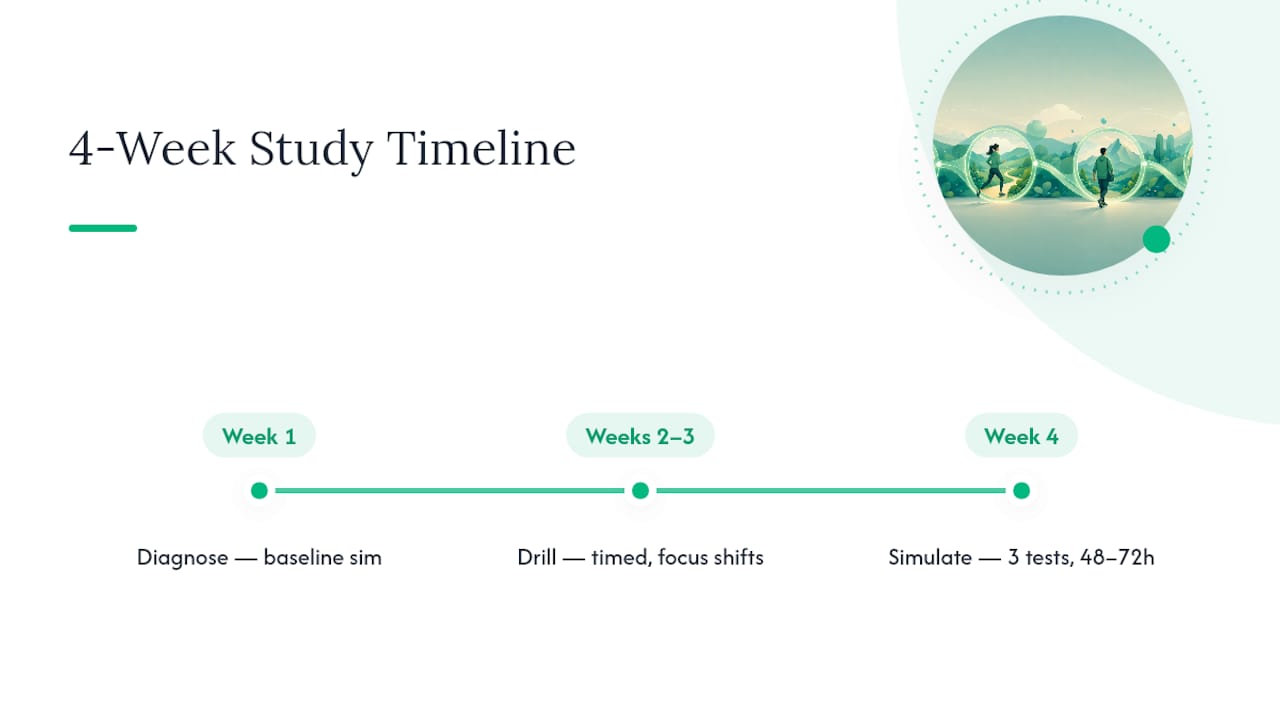
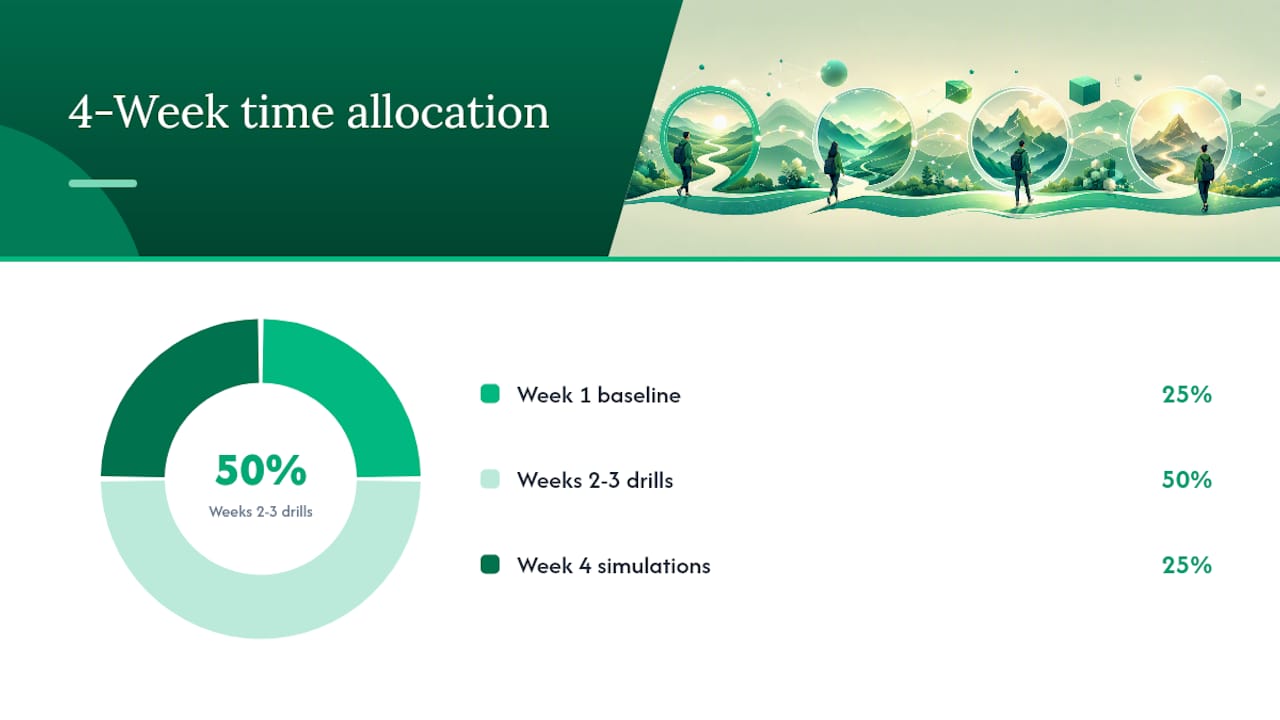
- Week 1: Baseline diagnostic, error logging, and section prioritization
- Week 2: Targeted drills on your weakest areas, timed mini-sessions
- Week 3: Mixed timed practice across all sections, pacing work
- Week 4: Three full-test simulations spaced 48–72 hours apart, exam-day prep
Aim for about one to three hours per day, split into two sessions. In Week 4, run at least two complete timed simulations before test day. The Bocconi Test is 50 questions in 75 minutes, so every practice block should mirror that pressure.
Pro Tip: In Week 1, your single highest-impact action is completing a full timed baseline simulation before studying anything. Without it, you are guessing at your weak spots.
Key Takeaways
A 4-week Bocconi Test program works when it starts with a diagnostic simulation, builds through targeted timed drills, and ends with at least three full-test simulations spaced 48–72 hours apart.
| Point | Details |
|---|---|
| Start with a baseline simulation | Run a full timed test on Day 1 to identify your two weakest sections before studying anything. |
| Use testing with feedback daily | Research shows Cohen’s d ≈ 0.58–0.91 for testing with feedback vs. restudy in high-stakes settings. |
| Commit 10–15 hours per week | Less than this and a 4-week intensive format will not produce reliable score gains. |
| Run three full simulations in Week 4 | Space them 48–72 hours apart and replicate Safe Exam Browser conditions each time. |
| Use Prepadmit for the full program | Official past papers, on-demand simulations, drill modes, and progress tracking in one platform. |
Table of Contents
- What does a 4-week Bocconi Test program look like week by week?
- Which study strategies actually work for the Bocconi Test?
- What materials and tools should you use during the four weeks?
- How do you simulate real test conditions and prepare for exam day?
- How do you track progress and know if the plan is working?
- Why does a 4-week intensive format work?
- An honest take on this plan
- Prepadmit gives you everything this plan requires
- Sources
What does a 4-week Bocconi Test program look like week by week?
This Bocconi study plan runs on a simple principle: diagnose first, drill second, simulate last.
Weekly schedule overview
| Week | Primary Focus | Daily Time |
|---|---|---|
| Week 1 | Baseline simulation + error log + section priority map | 1 to 3 hours |
| Week 2 | Targeted section drills + timed mini-sessions | 1 to 3 hours |
| Week 3 | Full-section timed runs + pacing adjustments | 1 to 3 hours |
| Week 4 | Full-test simulations + review + exam-day checklist | 2–3 hrs |
Daily session template (all four weeks)
- Warm-up (10 min): Review yesterday’s error log. Identify one recurring mistake.
- Focused drill (30–40 min): Work one section type under timed conditions.
- Mixed timed block (30–40 min): Attempt a mixed set of questions at test pace.
- Review and error log (15–20 min): Record every wrong answer, the reason it was wrong, and the correct approach.
End-of-week checkpoints
- End of Week 1: Baseline score recorded, top two weak sections identified, daily schedule confirmed.
- End of Week 2: Measurable improvement on at least one weak section in timed drills.
- End of Week 3: Able to complete a full section within the time limit without rushing the final questions.
- End of Week 4: Three full simulations completed, exam-day checklist reviewed, logistics confirmed.
Pro Tip: Keep your error log in a simple spreadsheet or notebook. One column for the question type, one for the mistake, one for the fix. Reviewing it each morning takes five minutes and compounds fast.
Which study strategies actually work for the Bocconi Test?
The most effective methods are not the most obvious ones. Re-reading notes feels productive but rarely moves scores. What does move scores is testing yourself under conditions that match the real exam, then reviewing every mistake immediately.
A meta-analysis of structured test preparation programs found a small-to-moderate positive effect on large-scale test performance (overall effect g = .26; 95% CI = .10–.42). The effect was stronger when preparation included timed practice with sample items and metacognitive planning.
Testing with feedback produced moderate-to-large improvements on high-stakes tests, while restudy alone had weaker or no sustained effects in high-stakes settings.
Testing with feedback vs. restudy: transfer effects in authentic test-preparation contexts (2026)
The core strategies to use across your four weeks:
- Diagnostic testing first: Take a full timed simulation before any content review. This tells you where your time is best spent.
- Distributed timed practice: Short, frequent timed sessions beat long, infrequent ones. Two 45-minute blocks per day outperform one 90-minute block.
- Testing with corrective feedback: After every practice set, review each wrong answer before moving on. Do not skip this step.
- Spaced error review: Return to your error log every 2–3 days. Questions you got wrong once will appear again.
- Metacognitive check-ins: At the end of each week, ask yourself: which section still feels uncertain? Adjust next week’s focus accordingly.
What materials and tools should you use during the four weeks?
The right resources make the schedule work. The wrong ones waste time you do not have.
Essential resource types:
- Official past papers: Use these first. They set the standard for question style, difficulty, and pacing. Bocconi recommends simulation-based practice directly on its official guidance page.
- Timed online simulations: A platform that replicates the 50-question, 75-minute format is non-negotiable. Anything shorter or untimed gives you a false sense of readiness.
- Targeted drill sets: After your baseline, you need section-specific practice for your two weakest areas. General mixed sets alone will not fix a specific gap.
- Error log: A simple document tracking question type, mistake, and correction. Low-tech, high-impact.
- Progress tracking dashboard: Knowing your score trend week over week keeps you honest about whether the plan is working.
Prepadmit covers all of these in one place. The platform provides official past papers, on-demand simulations built to match the real test format, skill-specific drill modes, detailed answer corrections, and a progress tracking dashboard with peer rankings. In Week 1, use it to run your baseline simulation. In Week 2 and 3, use the drill modes to target your weakest sections. In Week 4, run full timed simulations and review every correction before your actual test date.
Practical example: If your Week 1 baseline shows you are losing time on quantitative reasoning, spend Days 8–10 exclusively on timed quantitative drills. After three focused sessions, run a short mixed set to check whether the improvement transfers. If it does, shift focus. If it does not, add one more drill day before moving on.
For scheduling templates and AI-assisted study block planning, the AnyLearns study plan guide offers printable frameworks you can adapt to this four-week structure.
Pro Tip: When the same question type appears wrong across three or more practice sessions, stop drilling it and go back to the concept. Drilling a misunderstood concept just reinforces the wrong approach.
How do you simulate real test conditions and prepare for exam day?
Practice under conditions that match the real test. Anything less comfortable than the actual exam is good practice. Anything more comfortable is not.
The official Bocconi admission instructions specify Safe Exam Browser use, room scanning via mobile device, identification photo requirements, and microphone and screen-sharing checks. Your score report is available within 48 hours of the test.
Exam-day checklist:
- Confirm your device meets the technical requirements (Safe Exam Browser installed and tested).
- Set up your room: clear desk, no notes visible, good lighting, stable internet connection.
- Have your ID ready for the identification photo step.
- Complete the room scan with your mobile device before the test begins.
- Know the sequential navigation rule: you cannot go back to a previous question.
- Have a backup internet plan (phone hotspot) ready in case of connection issues.
- Check booking windows and current fees on Bocconi’s rules document before scheduling your attempt.
Space your three full simulations in Week 4 with at least 48 hours between each. This gives your brain time to consolidate what you reviewed, and it mirrors the recovery time you would have between real attempts. Bocconi allows up to four attempts per test type during the webtesting period, so pacing your practice attempts matters.
Pro Tip: During at least one Week 4 simulation, run the full Safe Exam Browser setup from scratch. Finding a technical problem during practice is far better than finding it on test day.
How do you track progress and know if the plan is working?
Record four things after every practice session: your score, your time per section, your error categories, and your confidence level on a 1–5 scale. The pattern across those four tells you more than the score alone.
If you have not seen a 5–10% improvement in your two weakest sections by the end of Week 2, do not move to Week 3 mixed practice yet. Add two more targeted drill days and recheck.
Common pitfalls:
- Over-drilling one section: Spending 80% of your time on one area while ignoring others creates a lopsided score. Balance matters.
- Skipping error analysis: Completing practice sets without reviewing mistakes is the single most common reason scores plateau.
- Treating timed practice as optional: Untimed practice does not prepare you for the 75-minute pressure. Every session should have a clock running.
Why does a 4-week intensive format work?
This plan rests on three assumptions. First, you have taken a baseline simulation before Week 1 begins. Second, you can commit 10–15 hours per week. Third, you have access to realistic online simulations that match the actual test format.
The meta-analytic evidence shows that duration, material type, and metacognitive strategy use all moderate how much students improve. Four weeks is enough time to produce measurable gains when those three conditions are met.
Who should not use a 4-week intensive plan: If you are starting from a very low baseline or have fewer than 10 hours per week available, a longer ramp-up of 6–8 weeks will serve you better. The Prepadmit step-by-step guide includes alternative timelines for students who need more runway. International applicants should also check the non-EU applicant guide for booking window differences.
An honest take on this plan
Most students waste their first week. They read about the test, browse forums, and make elaborate color-coded schedules. None of that moves the score. The plan above works because it forces you to confront your actual performance on Day 1, not Day 7.
The trickiest part of a 4-week Bocconi Test program is not the content. It is staying honest with yourself when Week 2 progress is slower than expected. The benchmarks in this plan are realistic, not aspirational. If you hit them, you are on track. If you do not, the plan tells you exactly what to adjust.
One practical note on motivation: students who track a visible score trend, even a small one, stick to their schedules far more consistently than those who study without measuring. That is why the error log and progress dashboard matter as much as the drills themselves.
Prepadmit gives you everything this plan requires
Four weeks of focused Bocconi Test preparation requires official past papers, realistic timed simulations, section-specific drills, and a way to track your score trend. Prepadmit provides all of it on one platform, built specifically for this test by experts with backgrounds from HEC and Bocconi.
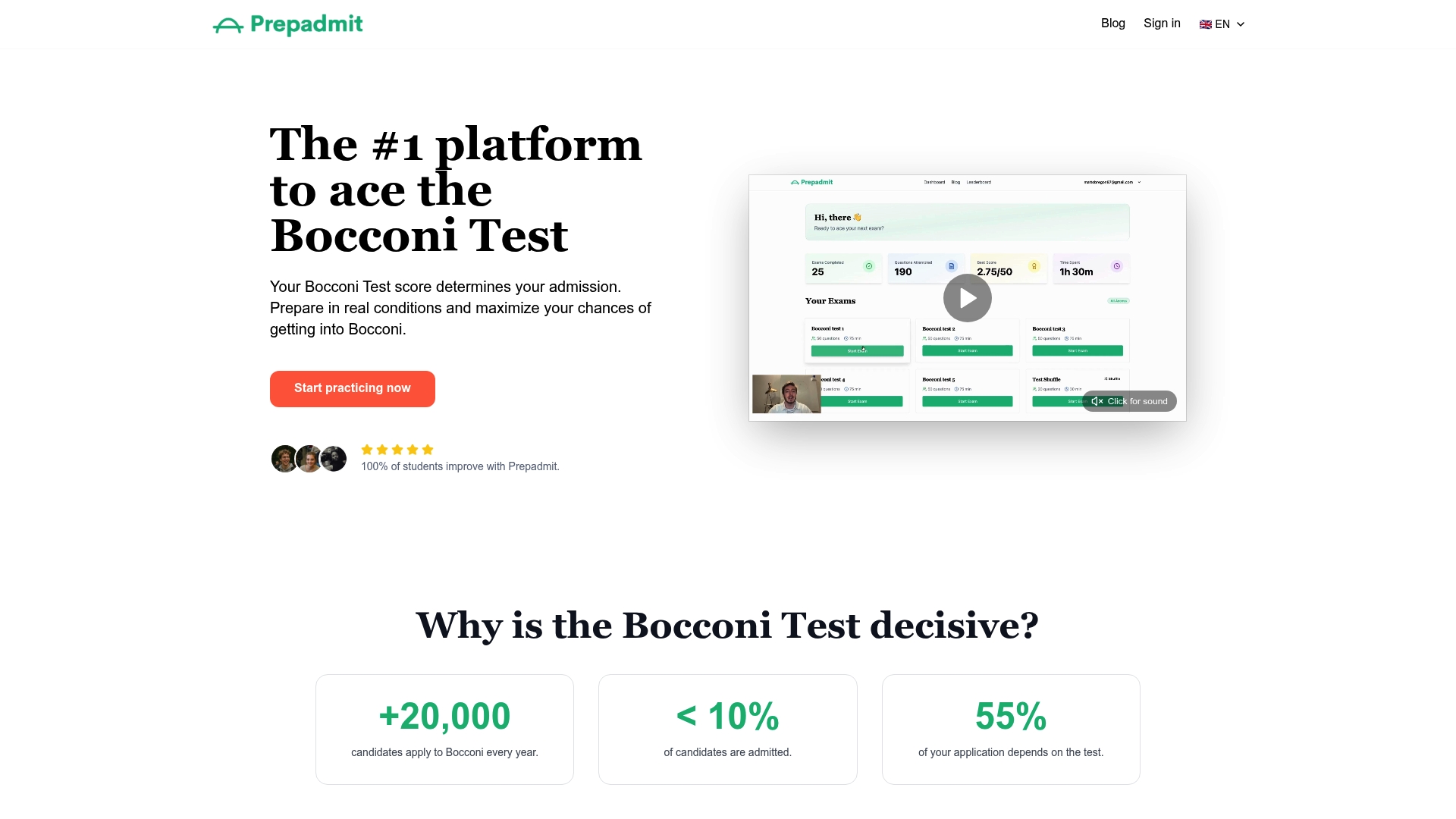
Use Prepadmit on Day 1 to run your baseline simulation. Use the drill modes in Weeks 2 and 3 to target your weak sections. Use the full-test simulations in Week 4 to confirm you are ready. The platform reports an average score improvement of 34% across its users, and it comes with a money-back guarantee. Start your preparation at Prepadmit today.
Sources
For verification and further reading, these are the primary sources behind this plan:
- The Impact of Test Preparation on Performance of Large-Scale Educational Tests: A Meta-analysis of Experimental Studies
- Testing with feedback vs. restudy: transfer effects in authentic test-preparation contexts (2026)
- Online Bocconi test | Bocconi University
Recommended
Related articles
Ready to ace your admission test?
Discover PrepAdmit, the platform that helps you succeed at top university admission tests.
Discover PrepAdmit