Bocconi mock exam review process: a guide

Bocconi mock exam review process: a guide
Taking mock exams without a structured bocconi mock exam review process is like practicing free throws with your eyes closed. You put in the time, but you don’t actually get better. Many students sit through full timed mocks, check their scores, feel good or bad about the number, and move on. That cycle doesn’t close knowledge gaps. This guide breaks down exactly how to review your mocks in a way that changes how you attempt questions next time, covering everything from error categorization to pacing decisions and penalty management.
Table of Contents
- Understanding the Bocconi test format and mock structure
- Setting up your Bocconi mock review schedule
- Analyzing mock exam results for targeted improvement
- Executing timed mocks with strategic pacing and decision-making
- Troubleshooting common review mistakes and optimizing your process
- Why most Bocconi mock reviews miss the mark and how to fix that
- Enhance your Bocconi prep with Prepadmit’s expert tools
- Frequently asked questions
Key Takeaways
| Point | Details |
|---|---|
| Understand test format | Knowing each Bocconi test section’s timing and scoring helps you tailor your mock review effectively. |
| Follow structured schedule | Use a step-by-step timeline from diagnostic tests to full mocks and final reviews to maximize gains. |
| Analyze errors deeply | Classify your mistakes and pacing issues to adapt your strategies beyond just re-taking tests. |
| Practice strategic pacing | Use a two-pass answering method with clear rules for guessing and skipping to optimize test speed and accuracy. |
| Leverage expert tools | Utilize platforms offering realistic mocks and detailed reports to improve your review process efficiently. |
Understanding the Bocconi test format and mock structure
Before you can review a mock well, you need to know what you’re reviewing. The Bocconi test has 4 timed sections: Math, Logical Reasoning, Reading Comprehension, and English. Each section has its own question count and time limit, and the clock does not stop between them.
Here’s a quick breakdown of the structure:
| Section | Questions | Time limit |
|---|---|---|
| Math | 20 | 30 minutes |
| Logical Reasoning | 30 | 25 minutes |
| Reading Comprehension | 20 | 25 minutes |
| English | 30 | 20 minutes |
That’s 100 questions in 100 minutes total. The math is brutal. You have roughly one minute per question across the board, and some sections give you even less.
Mock exams on the prepadmit platform replicate these exact conditions, which is why your review must also mirror this structure. Don’t review Math and Logical Reasoning as one block. Treat each section separately, because your pacing problems in one section are completely different from those in another.
A few things to know before reviewing your mocks:
- Correct answers earn positive points
- Wrong answers carry a penalty deduction
- Skipped questions receive zero points, no penalty
- The penalty system means that blind guessing actively hurts your score
Understanding this scoring logic is not optional. It shapes every decision you make during the test, and it should shape every insight you pull from your mock review.
Setting up your Bocconi mock review schedule
A good review process starts before you even open your first mock. You need a schedule that builds in the right kind of practice at the right time. A recommended review schedule includes a diagnostic test first, then focused practice, then full timed mocks, and finally a targeted review before the real exam.
Here’s how to structure your weeks:
- Weeks 1 to 2: Take a diagnostic mock under real conditions. Don’t study beforehand. The goal is to see your baseline performance across all four sections.
- Weeks 3 to 4: Focus on your two weakest sections. Use skill-specific practice, not full mocks. You’re building accuracy here, not speed.
- Weeks 5 to 6: Reintroduce timing. Do section-level timed drills before moving to full mocks.
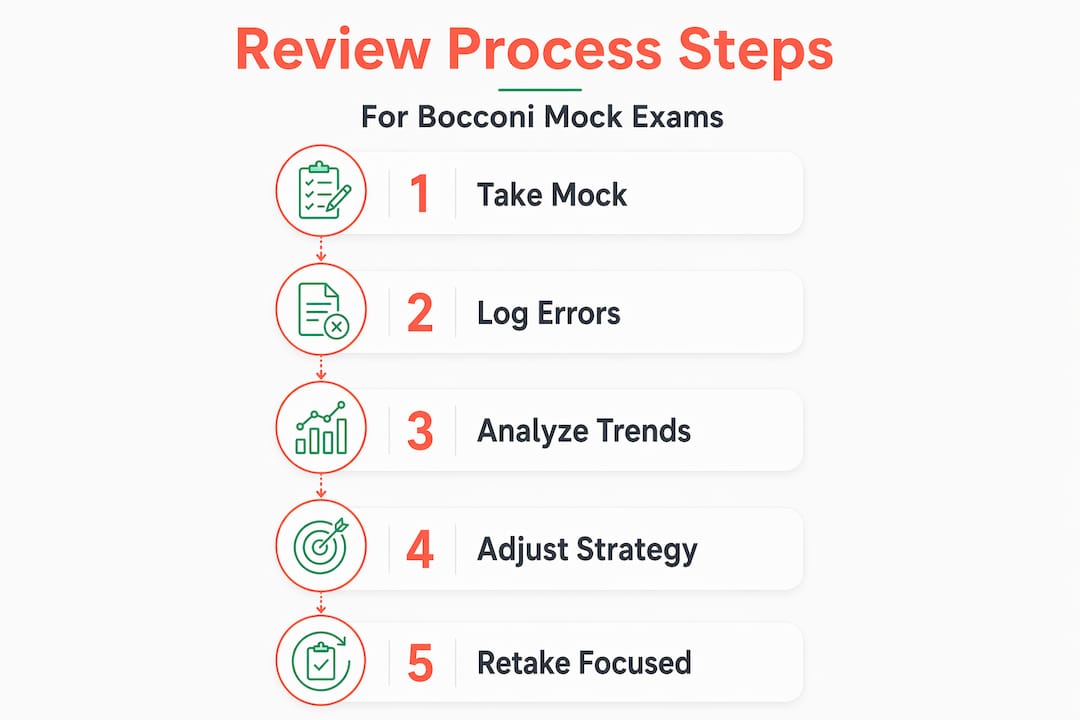
- Weeks 6 to 7: Take full timed mocks every 7 to 10 days. Review each one using the error categorization method explained below.
- Final week: Stop taking new mocks. Review your error log, revisit your weakest question types, and rest completely for the 48 hours before the exam.
Pro Tip: Schedule one full rest day per week during weeks 3 through 6. Fatigue degrades the quality of your practice more than most students realize. A tired review session teaches you less than no review session at all.
The key shift here is treating mocks as diagnostic tools, not performance events. Your score on a practice mock does not matter. What matters is what the mock reveals about your decision-making under pressure. Use prepadmit review strategies to track your progress across sessions and see where your patterns are changing.
Analyzing mock exam results for targeted improvement
This is where most students either win or lose their preparation. After a mock, the natural instinct is to check your score and move on. Resist that. The score is the least useful piece of information the mock gives you.
Instead, categorize every mistake you made. The most effective mock review diagnoses errors by type and adapts your answering strategy based on those patterns. Here’s how to categorize:
- Speed errors: You knew the answer but ran out of time or rushed. These are pacing problems, not knowledge problems.
- Accuracy errors: You had enough time but chose the wrong answer. These are knowledge or logic gaps.
- Reading errors: You misread the question or missed a key word. These are attention problems that get worse under pressure.
- Vocabulary errors: In the English section, you didn’t know a word or phrase. These require direct vocabulary study.
- Penalty errors: You guessed when you shouldn’t have, or skipped when you could have eliminated options.
Track these by section and by attempt stage. An attempt stage means whether you answered on your first pass through the section or on your second pass. Pacing and decision rules, including when to guess or skip, are just as important as whether your answer was correct.
If most of your speed errors happen in Logical Reasoning on your first pass, that tells you something specific. You’re spending too long on hard questions early and not leaving time for the easier ones at the end. That’s a fixable strategy problem, not a knowledge problem.

Pro Tip: Use a simple spreadsheet with columns for section, question number, error type, and attempt stage. After three mocks, patterns will appear that you’d never notice from scores alone. Use the mock exam review process tools on Prepadmit to automate much of this tracking.
Executing timed mocks with strategic pacing and decision-making
Analyzing past mocks only helps if you change your behavior in future ones. The most important behavioral change is adopting a two-pass answering method. High scorers use a two-pass strategy and manage guessing risks carefully under time constraints.
Here’s how the two-pass method works in practice:
- First pass: Move through every question in the section at a steady pace. Answer questions you’re confident about immediately. Mark uncertain ones and skip them.
- Second pass: Return to marked questions with your remaining time. Now you can make more deliberate decisions about guessing versus skipping.
- Guessing rule: Only guess if you can eliminate at least two of the five options. Otherwise, skip.
- Time check: At the halfway point of each section, you should have answered roughly half the questions. If you haven’t, you’re moving too slowly.
- Final 60 seconds: Do a quick scan for any unmarked skips you might want to take a calculated guess on.
Here’s why the penalty math matters for your guessing decisions:
| Action | Points |
|---|---|
| Correct answer | +1 |
| Wrong answer | -0.25 |
| Skipped question | 0 |
So if you guess randomly on 4 questions, statistically you get 1 right and 3 wrong. That’s +1 minus 0.75, a net gain of only +0.25. Barely worth it. But if you eliminate two wrong options and guess from the remaining three, your odds improve enough to make guessing worth the risk.
Mocks teach pacing: when to skip questions and return later versus guessing to manage penalties. Practice the two-pass method on every timed mock, not just the final ones. It needs to become automatic before test day.
Troubleshooting common review mistakes and optimizing your process
Even students who review their mocks carefully fall into a few predictable traps. Knowing them in advance saves you weeks of wasted effort.
- Chasing the score: If your only goal is a higher number on the next mock, you’ll make surface-level fixes. You need to understand why mistakes happened, not just that they happened.
- Ignoring pacing data: Ignoring pacing issues or re-taking mocks without structured error analysis reduces review effectiveness. A student who finishes with 10 minutes to spare in every section has a different problem than one who runs out of time.
- Skipping the error log: Without written records, you can’t detect recurring errors. Memory is unreliable. Write it down every time.
- Over-reviewing wrong answers: Spending 40 minutes understanding one obscure math question is not efficient. If a question type appears once across all your mocks, it’s not worth deep study.
Warning: Overthinking during your second pass is one of the most common causes of large point swings between mocks. Students who second-guess their first-pass answers frequently end up changing correct answers to wrong ones. Trust your first instinct unless you have a clear, specific reason to change it.
Pro Tip: In the final week, review your common Bocconi prep mistakes log and focus only on error types that appear in three or more mocks. Everything else is noise. Then stop all practice 48 hours before the exam. Rest is not optional. It’s part of the preparation.
Why most Bocconi mock reviews miss the mark and how to fix that
Here’s something most prep guides won’t tell you directly. The students who improve the most between their first and last mock are not the ones who studied the most content. They’re the ones who changed how they attempt questions.
Timed mocks without structured error analysis are usually much less productive than they could be. The reason is simple. If you take a mock, see a score, and study the topics you got wrong, you’re treating the Bocconi test like a knowledge quiz. It’s not. It’s a decision-making test under time pressure.
The students who plateau at the same score for weeks are almost always making the same pacing and guessing decisions every time. They’re not reviewing their process. They’re reviewing their answers. Those are different things.
Without qualified review, mocks become just practice tests. Not learning tools. The difference is whether you walk away knowing what to do differently next time.
Effective Bocconi mock review changes your behavior. It tells you to move faster through Logical Reasoning on your first pass. It tells you to stop guessing in the English section when you can’t eliminate any options. It tells you that your Reading Comprehension errors are mostly first-pass speed errors, not comprehension failures. That kind of insight only comes from tracking attempt stages and error types across multiple mocks. Not from checking scores.
Enhance your Bocconi prep with Prepadmit’s expert tools
If you’re serious about improving your score before the real test, you need more than a study plan on paper. You need tools that match the actual exam conditions and give you the data to review properly.
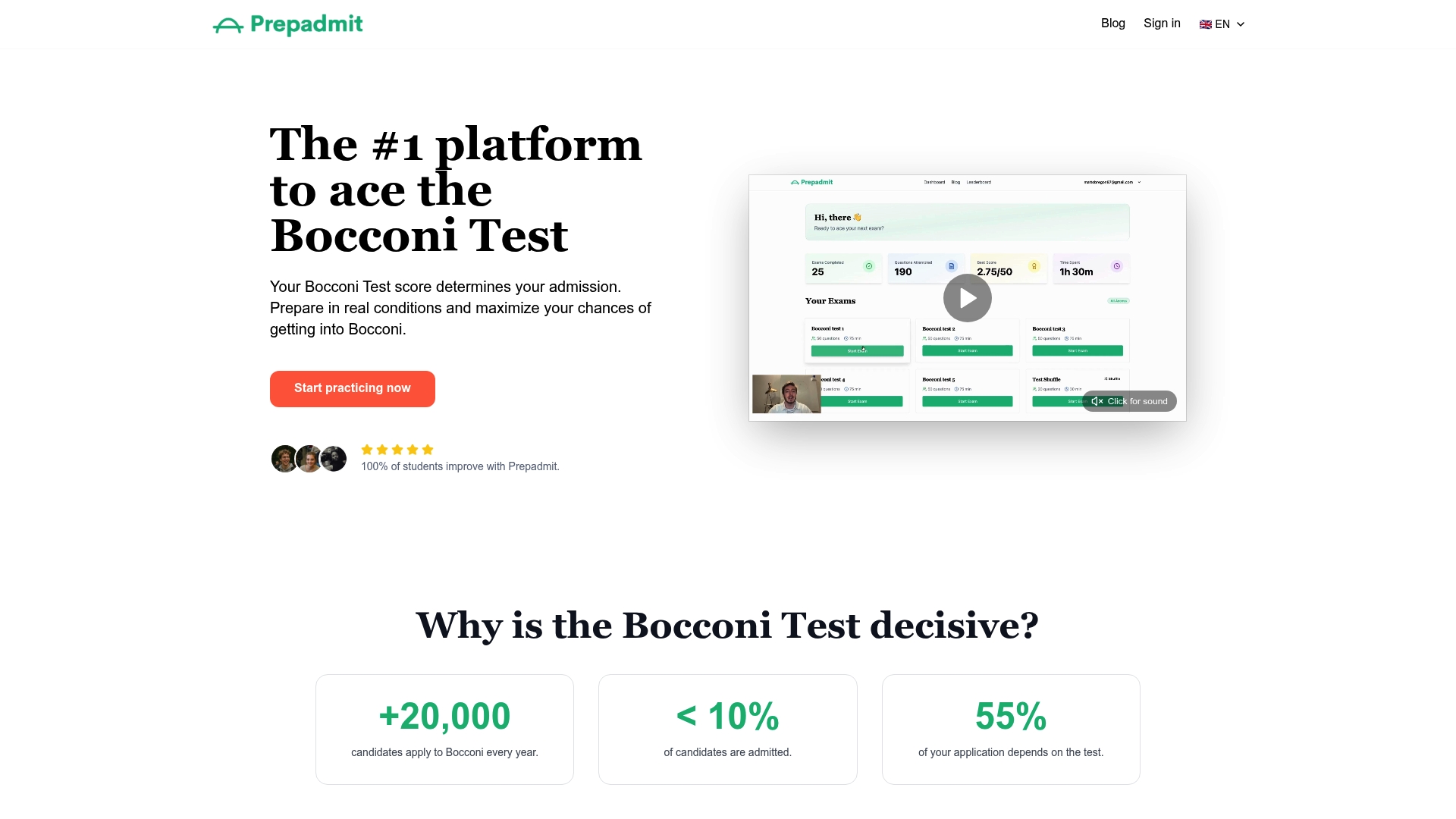
Prepadmit gives you official-style timed mocks built to match the Bocconi test format exactly. You get detailed error reports broken down by section and error type, so you can run the review process described in this article without building everything from scratch. The platform tracks your progress across sessions, shows you where your pacing is improving, and includes a recovery mode to fix your weakest topics after each mock. It was built by people who know the Bocconi test from the inside, and it costs a fraction of what private coaching charges. Explore all Bocconi test prep resources and start your first diagnostic mock today.
Frequently asked questions
How often should I take Bocconi mock exams during preparation?
Take a diagnostic mock in weeks 1 to 2, then full timed mocks every 1 to 2 weeks starting around week 6 to track progress and practice pacing under real conditions.
How do I handle guessing on Bocconi test mocks with penalties?
Only guess when you can eliminate at least one or two answer options. Blind guessing lowers your score because wrong answers carry a penalty deduction.
Why is timing review important besides checking answers?
Bocconi test sections have strict time limits, so pacing decisions like when to skip questions and return later influence your overall score just as much as whether your answers are correct.
Can I repeat the same mock exam multiple times for practice?
Yes. Since question sets are randomized, repeating mocks helps you cover more scenarios and strengthens weak areas without simply memorizing answers.
How long before the real test should I stop taking mocks?
Rest about 48 hours before the final test after reviewing your weakest question types. Stopping mocks too close to the exam leaves your brain fatigued when it matters most.
Recommended
Related articles
Ready to ace your admission test?
Discover PrepAdmit, the platform that helps you succeed at top university admission tests.
Discover PrepAdmit